

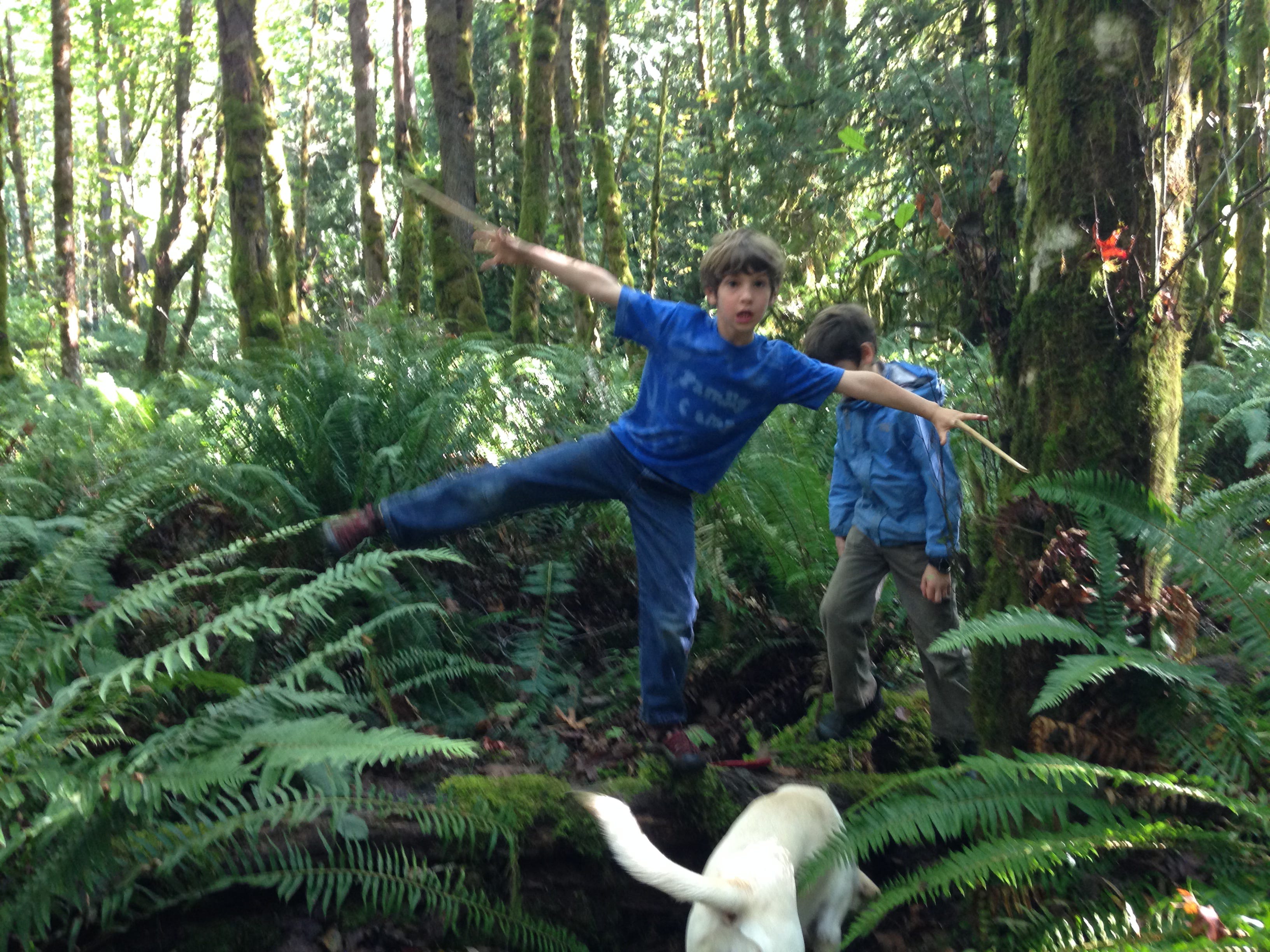
Twelve years ago, when I was still a college professor and my children were young, we had a life that seemed idyllic. We lived in a house in the forest, across a dead-end road from yet more forest—hundred of acres, in fact, forest dominated by Western red cedar, which swallows light, and firs and hemlocks, which stay green all year round, and maples of two types—bigleaf maples spreading tall and wide, and underneath, the vine maples, elegant and slim, their leaves bringing pale new green to the understory in Spring. In that forest across the road the boys and the dog could roam, building forts, climbing trees, and walking the deer paths back home.
Our house in the woods was large and difficult to heat, but well loved. Our boys shared a room even though we had enough space that they could have had their own. We thought it was good for them to share. Theirs was the room over the garage, with a sharply slanted ceiling, and a trapezoidal window at the far end, which looked out over the driveway, and to the cedar tree that Toby once climbed to the very top. The really charming windows, though, the thing that made their room special, was the line of clerestory windows along the top of the long wall, through which rays of sun came in when season and weather and time of day aligned just so. At other times, moonlight streamed in. More often at night, those windows were just black rectangles, suggesting an abyss on the other side.
Twelve years ago today, on May 19, 2014, I wrote the following, about being in that very room with my boys.
I lie on the top of my children’s bunk bed, late evening light filtering through trees blowing in a soft wind, the light filtering in through clerestory windows. This line of windows is just below the high spot on their room’s slanted ceiling which, at its lowest, on the other side of the room, requires even the shortest among us to crouch. The three of us lie here, cross-wise on the bed, feet up against the wall, looking up at the windows and the fading light, the shadows flickering on the smooth drywall above us, perfect in which to see images.
“At night, I see animals in the shadows,” Toby says. He is eight. “I saw a whale and a shark last night. The shark scared me a little.”
“I see planes, and cars.” his elder brother offers. Zack is 10. “I watched a single-engine bi-plane fly in.” He considers his claim, in the careful, honest way that he does. “I couldn’t actually see all of that detail, in the shadows. But I knew it was there, because of what kind of plane I was seeing.”
“I think it’s interesting,” Toby says thoughtfully, “that I see animals, and Zack sees machines. We see what we’re interested in.”
My goodness, I think—what an insight. He has, in a single moment, recognized how our individual desires and histories, how our personal biases, create meaning around us. He has understood that what he thinks he has seen is in fact a creation of his own mind. He would not argue that Zack’s WWI plane is not a plane, but a whale—they can see the same shadow and interpret it differently. They do not bicker about interpretation, because they know, at base, that it is just that: interpretation. What they are seeing is shadows. Shadows made as a setting sun in late Spring flows through cedars and firs and bigleaf maples and in to these high windows in their room. Their room where, on this rare occasion, their mother is lying with them after bedtime and talking about whatever it is that comes up.
I look now not at the shadows on the ceiling, but at our three sets of legs, propped lengthwise up against the wall, shadows on them coming from the faint light in the hall. The bottoms of our three pairs of loose pants have slid down to the knees, exposing calf flesh that is repeated in pairs, ever larger, three times. The light levels are not quite low enough for the image to be in black-and-white, but that moment is coming—that moment when color turns off. I feel an image burning itself into my mind’s eye, an image of these legs, a memory of this conversation.
Will this be one of the memories that either of my boys carries forward from childhood? There are the repeated events, which will be remembered in varying degrees of truth and fiction—the energy of the house on mornings before school, how field trips to eastern Washington allowed them to run loose in an expansive landscape, how playing with their cats and their dog felt. And there are the big events, the outlines of which are certainly known, even if the details are held differently in everyone’s heads—their grandfather’s death, the trip to Ecuador just a few months later. But what predicts which few memories, insignificant on their face, will be the ones that come up, unbidden, in adulthood?
I lay there and listened to my boys talk, talking about how their preferences for nature versus engineering probably informed what they saw in their ceiling at night, and I looked at our legs, and I thought: this I will remember.
Is it less if this is not something that they will remember as well?
Thank you for the personal view. My, how your life has changed! And wonderful how you have managed to move together and perhaps even grow closer.
lovely, lovely memory, Heather! so important for us to cement some of those in our minds since it seems like barely an eye blink and they are no longer children. you and Bret are truely blessed, as are your sons, who will make a positive difference on this earth, without a doubt.
my two younger boys are nearly identical in age as your two yet our experiences are vastly different. the son who's soon to be 22, has autism and is minimally verbal. though he's quite pleasant and even-tempered now, his mostly-resolved medical issues made things very difficult when he was small. he is aging out of the public school system in less than 2 weeks; touring day programs for developmentally disabled adults was depressing (to say the least).
my youngest is 20 and dropped out of high school during covid. no diploma, no driver's license, he's lucky to have a job in a warehouse, along with a buddy who has a car to get there. I left their father (an abusive narcissist,) when he was barely one year old. the man provided no support other than an occasional weekend, during which I had to provide their food and clean clothes. thank goodness for my elderly mom, who is more a parent to them then the one she refers to as the 'sperm donor'.
both of them are wonderful individuals even though I likely will be responsible for them, in all or part, till I take my last breath. that's just life for 'ya. we carry on.