

In Little House on the Prairie, Laura Ingalls Wilder’s father has built the family a house, but runs out of nails before he is able to build a door. After a pack of wolves surrounds the house one night, howling, he decides to hurry along the door project.
“I have no more nails, but I’ll not keep on waiting till I can make a trip to Independence,” he told Laura. “A man doesn’t need nails to build a house or make a door.”
I have been thinking recently about the value of making things and of play, of exploration and risk, of pain and beauty, and of moving between an analytical frame of mind, and an intuitive one. This all in service of a book I am writing, in which those starting paragraphs about Pa Ingalls also show up. Pa Ingalls seems to me—in the example above of using what he has to get a job done, as in so many other examples throughout the books—to exemplify many of these virtues.
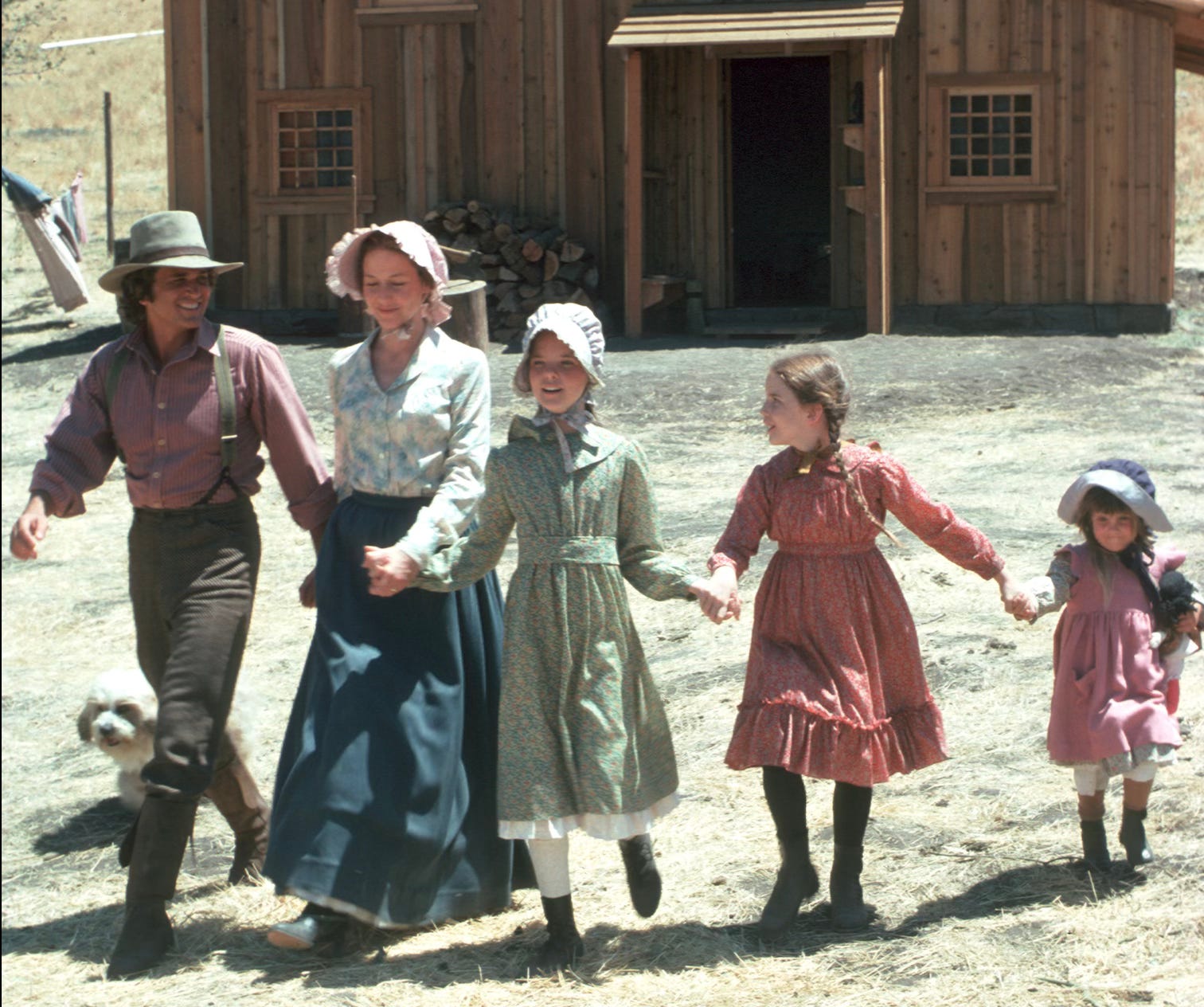
Little House on the Prairie is having a cultural moment. The books, written in the 1930s and 1940s by Laura Ingalls Wilder, about her childhood in the 1870s and 1880s, have been a feature of many American childhoods ever since. The original television show, which premiered in 1974 and ran until the early 1980s, was also beloved by many, even as it departed somewhat from the books. Wilder has been taken to task for being of her time, including especially for having inappropriate views on native Americans and African Americans. She has even had her name stripped from a long-standing children’s literature prize. Now, Netflix has produced a new series based on the books, which takes further liberties with the books. The Netflix series, like the books and the television series that came before it, are all very much of their time.
Here I must confess: I read all of the books when I was growing up, and I loved them. When my boys were growing up, I read the books aloud to them. As a child, I watched the original series, and found it mesmerizing as well. I have even read Confessions of a Prairie Bitch, by Alison Arngrim, who played the mean girl, Nellie Oleson, on the original series. I have not seen any of the new Netflix series. I have, however, read two reviews of it. This piece, the piece that you are currently reading, is a kind of review of those reviews, rather than a review of the show that they are reviewing.
These reviews—like the books and both of the shows—are also very much of their time. The first was published in New York Magazine, on July 10, the day after the Netflix series first aired; the second was published in The New York Times, about a week later.
From the reviews I have learned that the new Netflix series cannot abide politically incorrect views on race, and therefore elevates people of color to positions they did not have in the original books. Laura Ingalls Wilder has been accused more than once of putting a gloss on the treatment of Indians, in particular, and she was writing many decades after she lived the experiences she was writing about, so there may well have been some sweeping of inconvenient or even awful activities and memories under the rug. Or perhaps the relationship of white settlers to the native Americans whom they were patently replacing was fraught, and did move between vague unease and real hostility. Friendly encounters surely occurred, but they may well have been rare.
Certainly Laura and her family did not have the relationship with native Americans that modern white readers like to imagine that they would have had. The revisionist history apparently on display in the Netflix series helps nobody. Pretending that good people have always believed what the good people of today believe is arrogant, simplistic, and stupid.
That is not what troubled me in these reviews, however. Imagining that racism can be solved by pretending that history was different is a common enough error these days, and while I wish we would grow up already, I have somewhat accepted that that isn’t going to happen any time soon.
No, the thing that really got to me in these reviews were the attacks on the character of Pa Ingalls.
Both reviews question Pa Ingalls’ responsibility towards his family. Among other things, they wonder why he kept moving—why the family was always being taken to new places. Both reviews seem to have never considered what a man is, what a frontier is, and what the intersection of the two looks and acts like.
In New York Magazine, the author remembers fondly how disturbed her own mother was at Pa Ingalls’ behavior, when she was reading the books to her children:
“Why on earth had they decided to homestead so far from everything else? What possessed Pa to keep moving them with all these little kids and no assurance he’d be able to feed them?...Memorably, our reading reached a chapter from The Long Winter, which included an illustration of Pa with a thousand-yard stare, bundled up in many layers of clothing, trying to twist hay stalks into sticks because they’d run out of fuel to burn. ‘Why won’t this idiot move back to town?’ my mother said.”
A week later, in The New York Times, the (different) author of that review is similarly troubled by Pa Ingalls:
“Reading the books again as an adult, however, can sometimes feel like reading a horror novel. The family frequently lived in destitution. (Their dugout seemed magical to me as a child, but it hits differently when you think of Ma dealing with her period, for instance, under such primal conditions.) There are other, more troubling questions that nag at the reader. Why is Charles Ingalls dragging his family from place to place exactly? Did they really want to go?”
A horror novel?
We have become such a pampered, timid people. Or no, that’s not quite right. Our culture is being shaped by pampered, timid people. We have apparently forgotten that exploration, discovery, and a deep yearning for the unknown is how we have arrived nearly everywhere that we have gotten. Instead of celebrating courage and stamina and deeply hard work, our culture-makers embrace small lives, and small thoughts.
It will surprise nobody to hear that the authors of both reviews are women. I don’t like that this is true, but my feelings about it don’t change reality.
Women have historically been the ones to keep the home fires burning. As such, women tend to be less adventurous, less game to see what’s over the next hill, and are more likely than men to be anxious and afraid. The trouble begins when the fearful ones begin setting rules for everyone. Their worries and safetyism, their narrow horizons, should never have been allowed to set expectations for the rest of us.
The authors of these reviews, and the audiences to whom they speak, would seem to be scared little rabbits who are simultaneously empowered, and so clueless that they can ask of the instinct to explore: Why? Why would you do that?
What losers we have become. What scared, narrow-minded, embrace-the-familiar, bubble-wrap-your-children losers we have become.
Pa Ingalls knew a thing or two about dealing with the unexpected. He was a problem solver, and a man of skill and creativity.
Modernity has smoothed many of life’s rough edges away. We have been given a pureed version of reality, one in which nature’s variety is blended into uniformity. This way we know what to expect! It’s useful in some things, but even if you appreciate sidewalks, for instance, you can also recognize that trails are beautiful things. Beautiful, and instructive.
We should not default to uniformity, for down that path lies loss. Loss of skill, loss of appetite, loss of drive.
Take risks, ask questions, do not be bound by the lines drawn on the ground or by the voices that tell you what path is safe. Be bound by the lines only when it is best for you and those around you, when it is the right thing to do, and when it means being true to yourself.
A life without challenge, without risk, is a life that disappears into a dull haze almost as quickly as it comes into existence. Was Pa Ingalls chasing something he could never find? I don’t read him that way, but I suppose it’s possible. What he was definitely doing was exploring frontiers with his loving family, who were adventuring right along with him. Every single one of us comes from a long line of explorers, people who took risks, and through a combination of skill and luck, found a path that worked.
We would all do well to follow our courage, not our fears.
We have become a nation of wimps. "How did Ma Ingalls deal with her period in a dugout?" She dealt with it in the same way, no matter where she lived. They didn't have tampons or sanitary pads. They had a cloth that they had to wash, and she had a stream nearby. I got my period in the days of sanitary belts. Several years later the stick-on pads came out and trash cans were filled with sanitary belts...just as, years before, trash cans were filled with cloth sanitary pads. Someday women will look back on us and wonder how we dealt with tampons and stick-on pads. It's called progress, friends.
I read those books as a child and loved them. I read them again when my kids were young and saw a whole added layer. They are coming under attack not just for racial issues, but also because Rose Ingalls Wilder became one of the the mothers of the libertarian movement in the United States. Her adopted grandson, Roger McBride, founded the Libertarian Party. Rose was an international journalist.
I sew my clothes, grow food, cook from scratch, etc... and I think these books inspired me to go that direction with my life.
I left the city and moved to a smallish town settled by intrepid pioneers. The kids here are different and take more risks. I was at my piano lesson and a neighbor kid knocked on the door asking to play with one of the sons. He looked like he was about 10. My teacher, the mother, did not know where he was, and after asking around found out he was walking somewhere in the neighborhood. The other little boy went off looking for him.
I told my teacher how happy I was that her kids were running loose. It felt like going back in time. Leaving the city after retirement has helped us so much, we live in a community now.